Why Is Santorini Sunset Famous?
A west-facing rim, a flooded volcano and a village painted white. The real reasons the caldera sunset became a postcard, and what it is like in person.
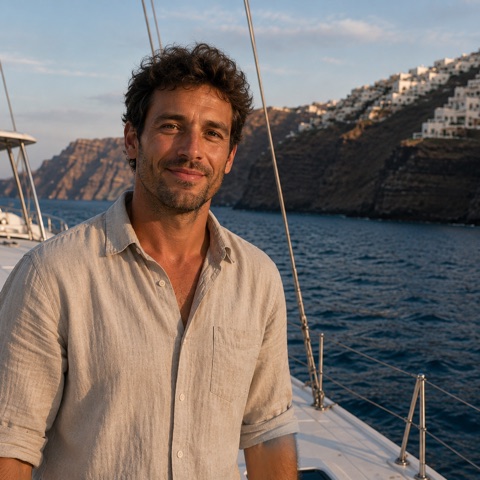 By Nikos Andreou, Santorini sailing writer; five summers crewing caldera catamarans out of Vlychada
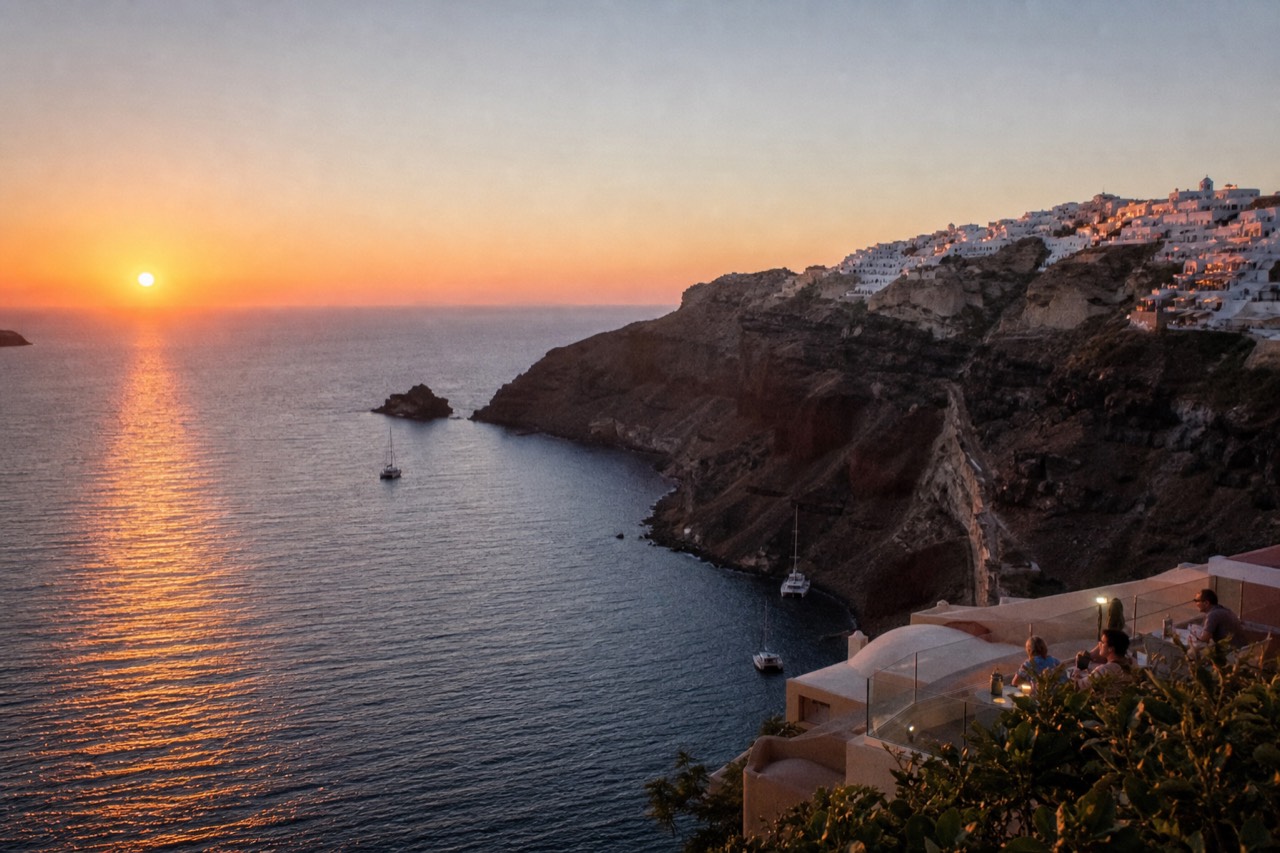
Plenty of places have a good sunset. Santorini has a grandstand: a crescent of cliff several hundred metres above the water, facing west, a flooded volcano in front of it and whitewashed villages along the top that turn pink for twenty minutes every evening. Geography did the work. Photographs did the rest.
Booking choice: The fame is geography, and the water seat is the one it points at: the Ammoudi dinner sail serves courses with a full open bar while the sun drops over open water and the whole rim lights up behind you. It cancels free up to 24 hours out.
Why is Santorini sunset famous?
Because the island is the west-facing rim of a collapsed volcano, so the villages sit high above an unobstructed sea horizon with the caldera below them. The whitewash takes the colour, the volcanic islets give the light something dark to sit against, and at Oia the caldera opens straight out to open water.
Take away one of those and you have a nice evening rather than a famous one. Together they make a view that photographs well from almost anywhere on the rim, which is how the island became shorthand for sunset.
| Element | What it is | What it does to the sunset |
|---|---|---|
| The rim | a west-facing crescent of cliff up to around 300 metres above the sea | puts you above the horizon, so nothing blocks the last light |
| The caldera | a flooded basin left when the Bronze Age eruption blew the island's centre out | depth and dark water under the light instead of a flat beach view |
| The mouth at Oia | the north-west corner, where the caldera meets the Aegean | the sun finishes in sea rather than behind a ridge |
| Thirassia and the Kamenis | the far rim and two young volcanic cones mid-water | dark shapes that give the colour a foreground and a scale |
| The whitewash | lime-plastered cubic houses and domes on every terrace | the village takes the sky's colour, so the view faces both ways |
| The summer air | dry, usually clear evenings through the sailing season | clean colour and a hard-edged disk |
Guidebooks and operators call the caldera sunset Santorini's signature experience, and for once marketing and geology agree.
What does the caldera do to the light?
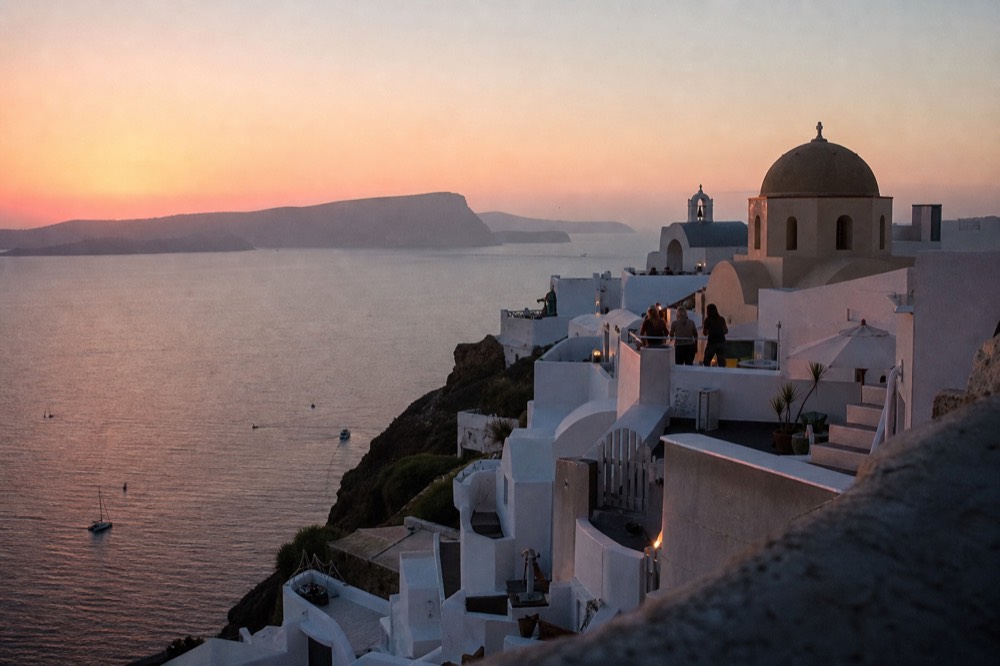
It gives the sun somewhere to go. The eruption that shaped the island left a sea-filled basin ringed by cliff, so from the rim you look down several hundred metres onto water, across at a second island, and out through a gap to the horizon. Height, distance and dark water do the rest.
Colour behaves differently when nothing is in the way. From a beach the sun sets into haze at eye level; from the rim it sets below you, and the basin holds light for minutes after the disk has gone. The lime plaster is the accidental hero: it went on to reflect heat and keep walls clean, and it happens to be the perfect surface for a briefly orange sky.
The hour swings too, from 20:39 in mid-June to 18:44 in mid-October, so the same view means a late dinner in summer and an early one in autumn.
How did it become the postcard?
Photography turned a geographical accident into a destination. Blue domes, white cubes and a low orange sun make an image that reads instantly at thumbnail size, which is exactly the kind of picture that travels. Around 3.4 million visitors a year now come to an island of roughly 15,500 residents.
| The figure | What it counts |
|---|---|
| ~3.4 million a year | total visitors by air, ferry and cruise ship |
| ~15,500 | permanent residents, a ratio of roughly 220 to 1 |
| 2,418,219 | air passengers through the airport in 2025, still 5.1% above 2019 |
| ~800 | people on the Oia castle walls by 18:30 in peak summer, often three deep |
| 595 vs 728 | cruise-ship calls scheduled for 2026 against 2025, under an 8,000-a-day cap |
| from 7am | when photo queues have been reported forming for the blue-dome shots |
That last line is the honest version of the postcard. Coverage in June 2026 described queues forming at seven in the morning for the same handful of rooftops that appear on every feed. The fame is real, and so is what it has done to the lanes it happens in.
What is it actually like in person?
Beautiful and busy. Roughly 800 people fill the Oia castle by 18:30 in June to August, standing three deep, and the advice is to arrive 90 minutes early. In April, May, September and October, 45 to 60 minutes is enough and the same view costs you far less of your evening.
The crowd is not evenly spread. Oia takes the pressure because it has the horizon; Fira, Imerovigli and the rim path between them are quieter for the same light. A thinner 2026 cruise-ship schedule has taken some daytime load off the villages, though air and ferry arrivals still fill them in peak weeks.
None of that makes it overrated. It makes it worth planning around rather than wandering into at 20:00 in July. The case for and against the classic viewpoint is in whether the Oia sunset earns the crowds, and the rims are weighed against each other in Oia and Fira compared.
Why did watching from the water become its own tradition?
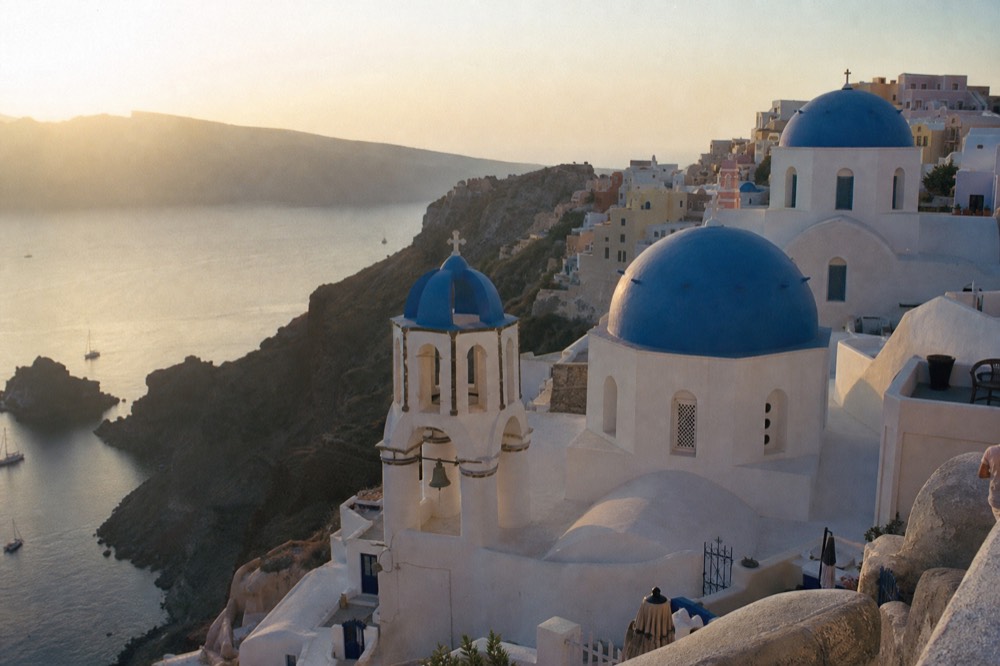
Because the sun does not set behind Oia. It goes down over Thirassia and the open water west of the caldera, which means the boats are sitting exactly where the postcard is pointing. From out there the villages are lit from the front, the light is unobstructed, and the whole rim comes on behind you at blue hour.
That angle is the part the viewpoints cannot sell. On the rim you photograph a sun with heads in front of it; anchored a mile offshore you get the sun ahead and Fira, Imerovigli and Oia strung along the cliff behind, coming on one terrace at a time. Five summers crewing out of Vlychada and the ten minutes after the disk drops was always the quietest the deck ever got.
The boats also solve the crowd problem by removing it. Guest caps run from 16 to about 55, dinner is cooked aboard, drinks are included, and every cruise carries free cancellation up to 24 hours before. The dinner sails out of Ammoudi put you under Oia within minutes, and you can check dates and the live price or see availability on the family-run catamaran holding 4.9 across 514 reviews. Route detail is in sailing under Oia from Ammoudi, and the dinner and romance boats sit together on the homepage. The wider santorini sunset cruises lineup covers seven boats in all.
Common questions
Why is Santorini sunset famous?
The island is the west-facing rim of a collapsed volcano, so villages sit up to around 300 metres above an unobstructed sea horizon with a flooded caldera below. The whitewashed houses take the colour, the volcanic islets give the light a dark foreground, and at Oia the caldera opens straight to open water.
Does the sun set behind Oia?
No, and it is the most common misunderstanding on the island. The sun goes down over Thirassia and the open water west of the caldera, not behind the village. Oia is famous for looking at the sunset from the best angle on the rim, which is why boats offshore sit where the view points.
Is the Santorini sunset overrated?
The view is not, the logistics can be. Around 800 people crowd the Oia castle by 18:30 in peak summer and the advice is to arrive 90 minutes early. Shift the same evening to Fira, to the shoulder months, or onto a boat, and the experience matches the reputation.
Where is the best place to watch the Santorini sunset?
Oia has the cleanest horizon, Fira has the volcano view and the elbow room, and the water has both. From a boat you get the sun ahead over open sea and the whole rim lighting up behind you at blue hour. Cruises here cap between 16 and about 55 guests.
How crowded is Oia at sunset?
From June to August, roughly 800 people gather at the castle viewpoint by 18:30, often three deep, and photo queues have been reported forming from 7am for the blue-dome shots. Shoulder season is calmer: 45 to 60 minutes of lead time is usually enough.
Plan your evening on the water
Check the cruise that fits your evening
Initial editorial choice, not a personalized eligibility check. Confirm the operator’s full requirements before booking.
How will you watch it?
This screens only the details you enter. Language, boarding, sea state and every remaining restriction still need operator confirmation. Time allowances include boarding and the return leg.
- Luxury Sunset Dinner Cruise - a dinner table that sails through the sunset: mezedes, then BBQ courses, then dessert, with a full open bar and air-conditioned minibus pickup. evening, dinner served in courses (confirm timing on the listing). From $177 per person. Shared luxury boat. Dinner is served through the evening rather than at a fixed table time; the listing confirms your date's schedule.
- Romantic Sunset Catamaran - a 16-guest catamaran built for couples: appetizers, a BBQ dinner, an open bar with wine, ouzo and beer, and crew who pace the evening around the light. about 5 hours. Price shown on the live listing. Maximum 16 guests. Transfer is optional, not bundled; confirm the meeting point when you pick a date.
- Caldera Classic Catamaran - the best-rated boat on the board, a Renieris family catamaran with a BBQ meal and dry white wine at a calmer scale than the big fleets. about 5 hours (confirm on the listing). From $111 per person. Shared catamaran; the listing confirms departure time and duration for your date.
Luxury Sunset Dinner Cruise
Check your date before arranging the rest of your day: a dinner table that sails through the sunset: mezedes, then BBQ courses, then dessert, with a full open bar and air-conditioned minibus pickup.
evening, dinner served in courses (confirm timing on the listing). A/C minibus pickup from Ammoudi departure, mezedes, BBQ dinner, dessert, full open bar.
Shared luxury boat. Dinner is served through the evening rather than at a fixed table time; the listing confirms your date's schedule.
Schedule loading. You can still check dates directly on Viator below.
Scheduled dates are not confirmed seats. Select the same date on Viator to confirm availability and the final price.