Santorini Caldera Boat Tour: The Circuit, Stop by Stop
The route has barely changed in decades because the caldera is small, the anchorages are fixed, and the good water is exactly where it has always been.
Short answer
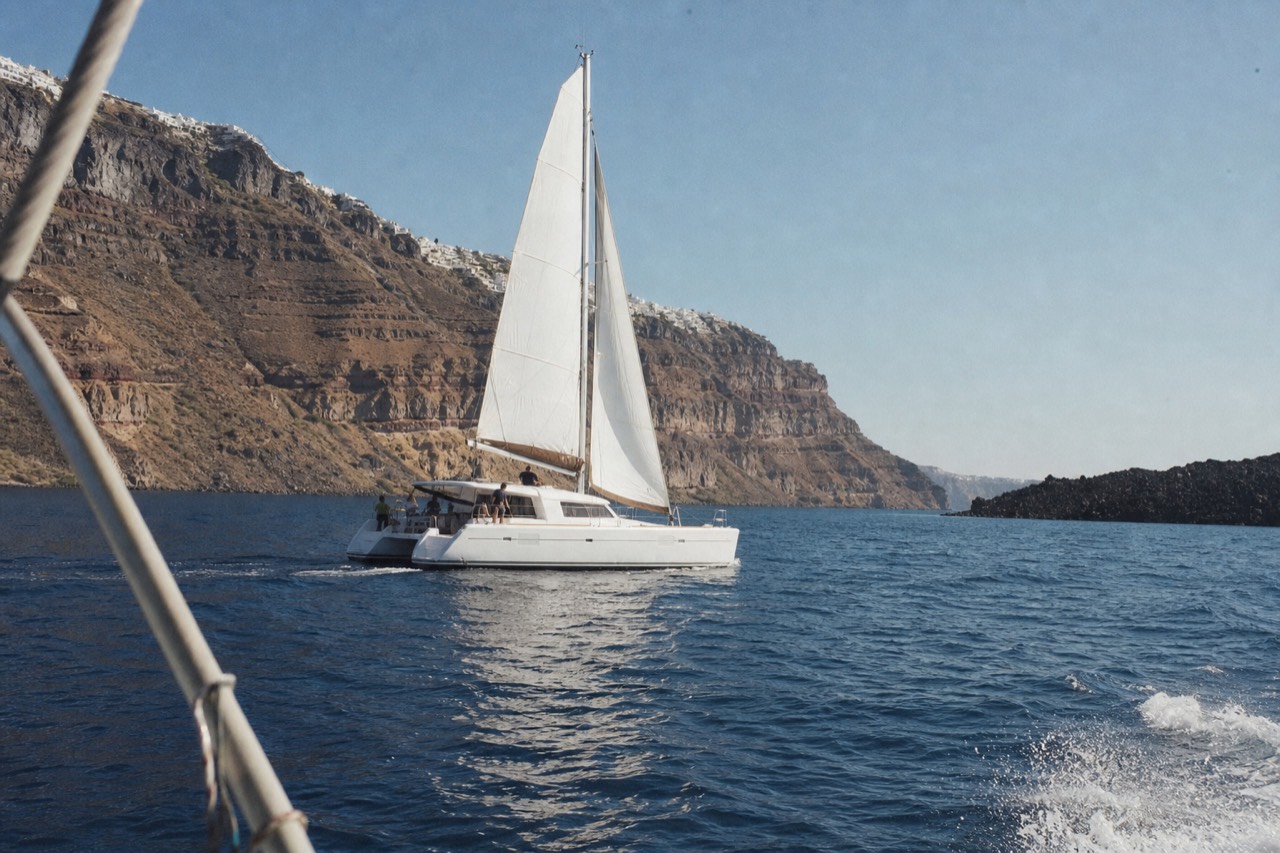
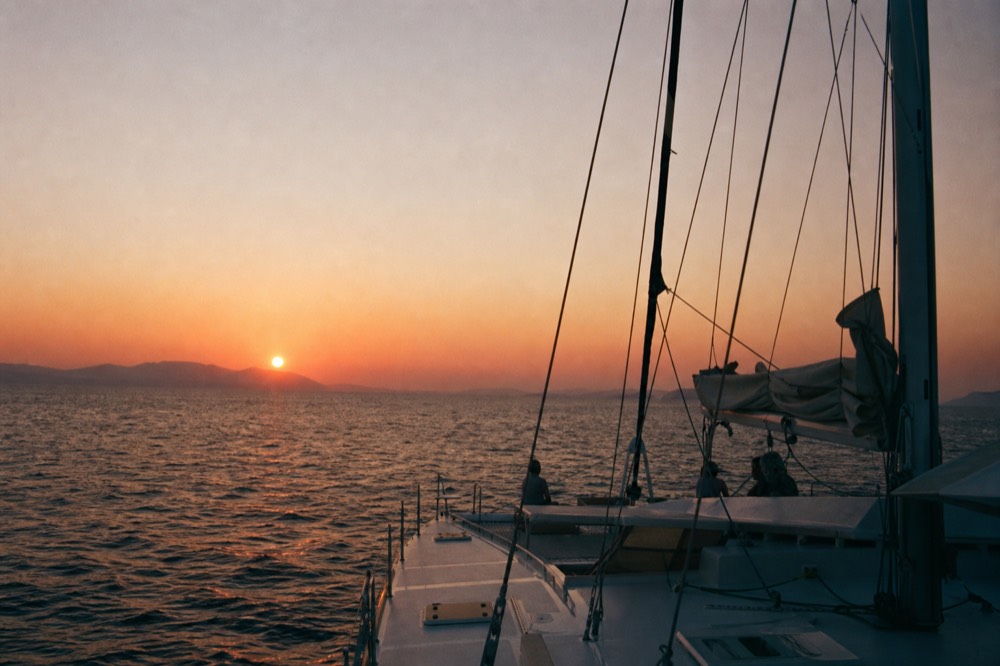
A caldera circuit runs the same shape on nearly every boat: out along the southwest cape past the Akrotiri lighthouse and the Red and White Beach coast, up the cliff wall, one open-water swim, an anchorage off Palea Kameni where 30-35 C spring water meets a 20-25 C sea, then sunset over Thirassia. Five hours, cast-off two and a half to three hours before the sun goes down.
You feel the caldera before you understand it. The boat clears the southern cape, the swell flattens against nothing you can see, and suddenly there is a wall on your right that keeps going up past the point where you expected it to stop. That wall is the inside of a volcano that blew its middle out, and for the next four hours you are sailing around in the hole.
Booking choice: The caldera circuit is one five-hour booking that covers the geology, the swim stops, dinner and the sunset. The 4.9-rated Caldera Classic runs it with the highest score on this water, and every boat cancels free up to 24 hours out.
The circuit that follows is close to fixed. Not because operators lack imagination, but because there are only so many places to anchor in a flooded crater, and the ones that work have worked for a very long time. Knowing the order of them, and roughly how long a boat holds each one, turns a five-hour sail from a pleasant blur into something you can actually plan around.
What does a Santorini caldera boat tour cover?
The standard circuit runs the southwest cape past the Akrotiri lighthouse, the red and white cliff coast below Akrotiri, up the caldera wall, one open-water swim, an anchorage off the Palea Kameni hot springs, then a sunset seat looking west past Thirassia. Five hours door to door on most boats, cast-off two and a half to three hours before sunset.
Direction depends on where you start. Boats leaving Vlychada Marina on the south coast round the cape first and enter the caldera from below, which means the lighthouse and the coloured beaches come early and the cliffs build through the afternoon. Boats leaving Ammoudi Bay at the northern tip do the reverse, dropping down the wall before turning back for the light.
Either way the anchorages are the same, and there are only three that matter: an open-water swim somewhere along the coast, the hot-springs cove at Palea Kameni, and wherever the captain parks for sunset. Everything else is passage, which is not a criticism. The passage is half the reason to be out there.
| Leg | What you pass or do | Why boats include it |
|---|---|---|
| Out of the marina | south coast, sculpted pale cliffs | fastest access to open water |
| The southwest cape | Akrotiri lighthouse on the headland | the turn into the caldera, and a landmark |
| Red and White Beach coast | iron-red and pumice-pale cliffs at sea level | the colours only read properly from the water |
| Into the caldera | the full cliff wall, 300 metres of it | the reason the trip exists |
| Open-water swim stop | deep blue, no beach, stern ladder | the crew's first real stop |
| Palea Kameni | hot springs anchorage, 30 to 35 C water | the stop everyone remembers |
| Sunset position | west of the rim, Thirassia ahead | unobstructed horizon, no crowd |
| Run home | blue hour along the wall | usually the calmest hour of the day |
Two things get confused constantly, so here they are plainly. Nea Kameni and Palea Kameni are different islands: the young black one with the crater, and the older one with the warm water. And the sunset does not happen over Oia. From inside the caldera the sun goes down past Thirassia into open sea, which is why a boat west of the rim has the better seat than any terrace. If you want the whole menu of boat types before committing to a circuit, every kind of boat trip on the island sorts them by format.
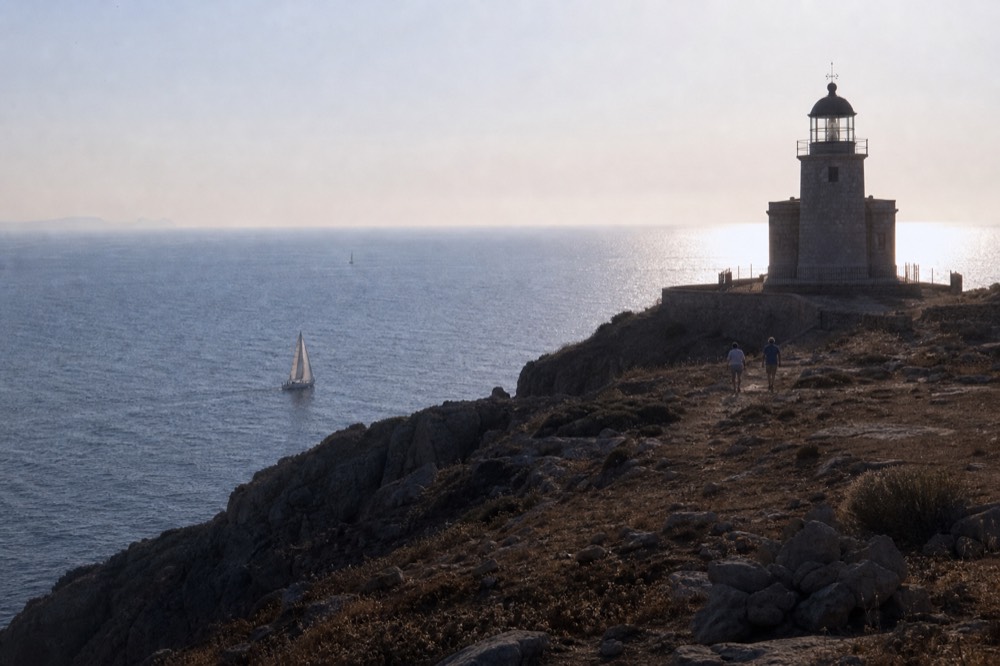
What do you see rounding the Akrotiri cape?
The southwest corner is the most colourful stretch of coast on the island and the only part you cannot really judge from land. The Akrotiri lighthouse sits on the headland, built in 1892 and still working, flashing white every ten seconds. Below it the cliffs run iron red, then charcoal, then a chalky pumice white in the space of a few hundred metres.
The lighthouse is one of the oldest in Greece. A French company put it up in 1892, it went dark during the Second World War, and the Greek Navy brought it back into service in 1945. It is automated now, the tower is closed to visitors because it is still an operational light, and the ground around it is a public viewpoint that half the island drives to for sunset. From a boat you pass underneath it, which is the better angle and considerably less crowded.
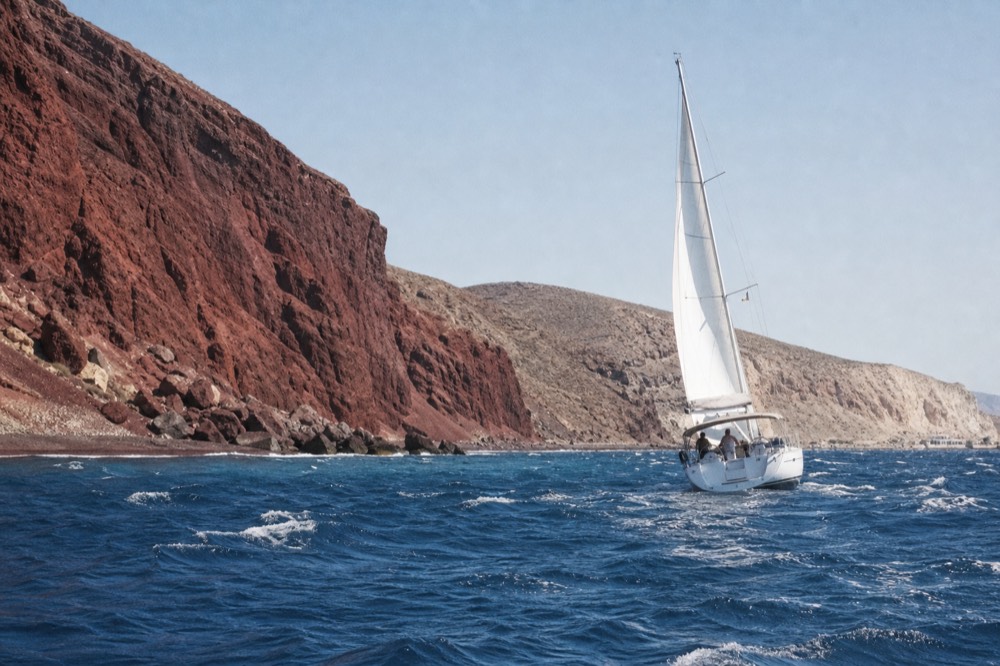
Red Beach sits along that same stretch, tucked under cliffs the colour of rusted iron, and White Beach is a pale cove further along, walled in soft pumice and reachable properly only by water. Both look washed out in the middle of the day and turn saturated in the last two hours of light, which is exactly when a sunset boat is passing them.
| Landmark | What it is | Best seen |
|---|---|---|
| Akrotiri lighthouse | 1892 French-built light, automated, white flash every 10 seconds | from below, passing on the cape |
| Red Beach | iron-red cliffs dropping to a short dark shore | from the water, late light |
| White Beach | pale pumice-walled cove | from the water, boat access only |
| Mesa Pigadia coast | broken volcanic shoreline south of Akrotiri | on the run out from Vlychada |
| Vlychada cliffs | wind-sculpted pale rock beside the marina | on departure, first ten minutes |
| The cape turn | where open sea becomes caldera | the moment the swell drops |
Not every boat takes this cape. The two that board at Ammoudi start inside the caldera and work down, so their route weights the cliff wall and the north end rather than the coloured coast. That is a real difference between the northern and southern departures, and it is worth knowing which one you have booked. The Ammoudi departures and the walk down covers the northern version in detail.
How do you read the caldera wall from the water?
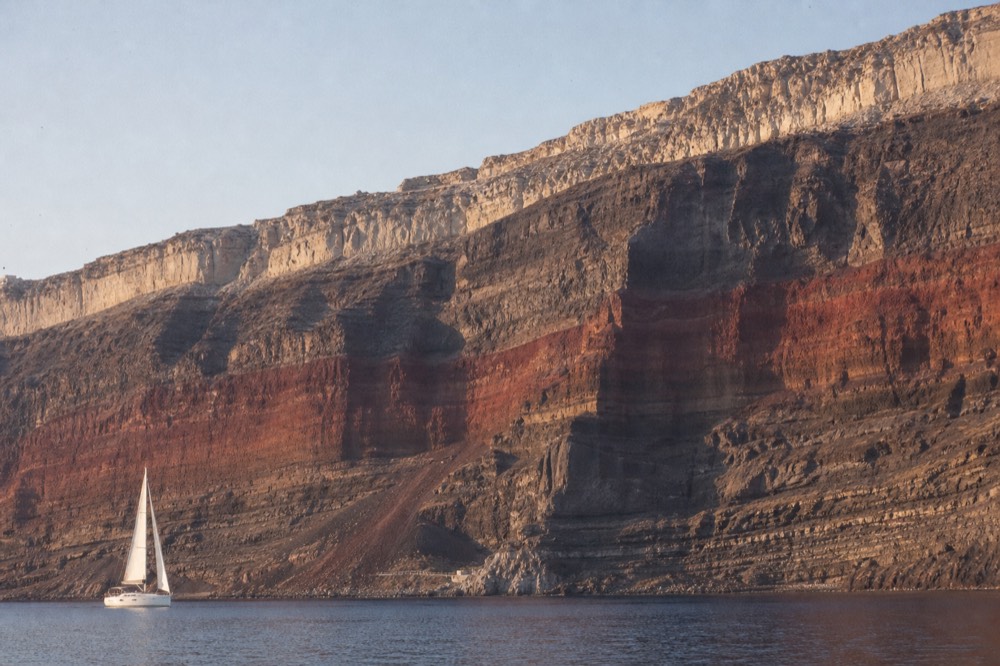
The wall is a cross-section through a long series of eruptions, stacked in visible bands: dark lava flows, red oxidised scoria, and a thick pale cap of pumice and ash from the eruption that emptied the middle. The villages sit on that pale cap. Once you see the layering, the rock stops being scenery and starts being a record.
From a deck the sequence is easy to follow because it runs horizontally for kilometres. Dark grey and black bands are old lava. Rusty red streaks are where iron-rich rock oxidised. The soft, pale, crumbly top layer is the youngest material, and it is what the whitewashed villages are literally dug into, which is why cave houses are a Santorini thing rather than a Cyclades thing generally.
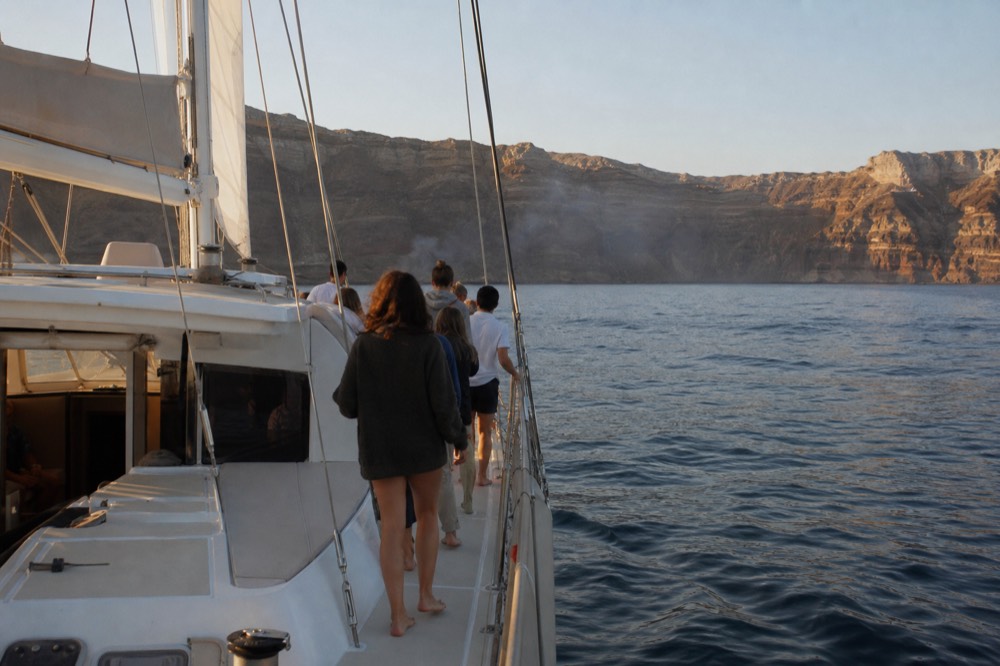
Scale is the part photographs never carry. The rim runs to roughly 300 metres above the water in places, and the boats sail close enough that you have to tilt your head back. A catamaran with a 20-metre mast passing under that wall looks like a toy. People go quiet.
The other thing you notice is how little of the rim is built on. Fira, Firostefani, Imerovigli and Oia string along the top edge in a broken line, and between them are long empty stretches of cliff with a single chapel or a goat track. From inside the villages, Santorini feels crowded. From the middle of the caldera it looks mostly like rock.
There is a practical side to sailing that close in. The wall funnels wind, so the breeze along the cliff behaves nothing like the breeze in open water: it drops to nothing in the lee of a headland, then arrives sideways out of a gully half a minute later. Crews trim for it constantly, and anyone lying on the forward trampoline collects the occasional faceful of spray with no warning at all. If you want the driest seat on a catamaran, sit aft near the helm rather than forward on the netting. The view is barely different and the ride is considerably better behaved.
Five summers of crew work out of Vlychada and the wall still lands the same way every single evening, usually about forty minutes after cast-off, when the boat swings in close and the conversation on the trampoline stops. That is the moment the trip pays for itself, and it happens before anyone has eaten a thing.
What is the Palea Kameni hot springs stop really like?
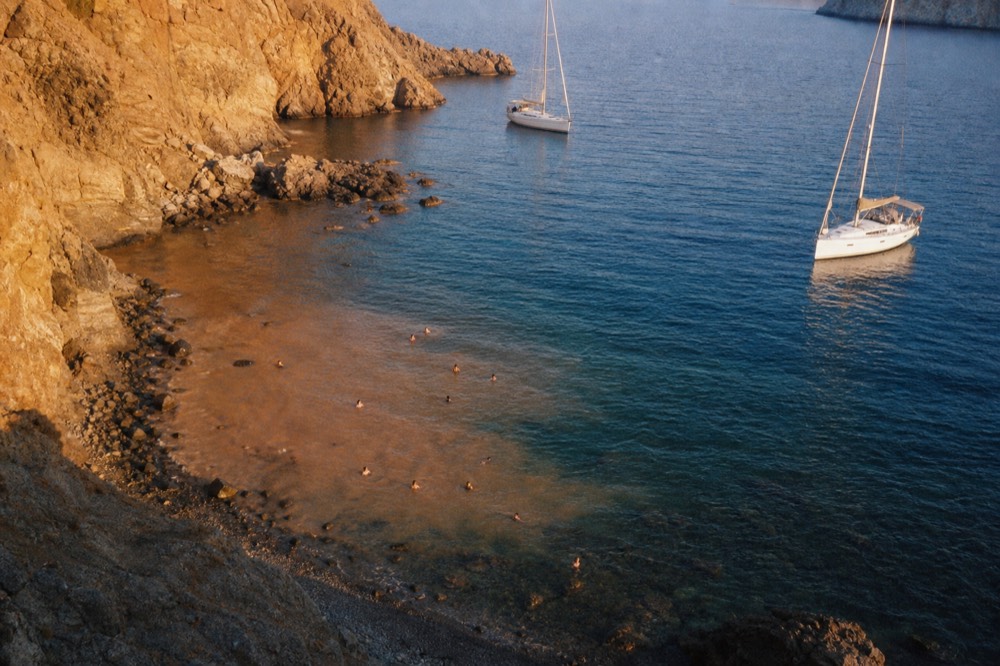
A real open-water swim, not a spa. The boat anchors offshore because there is no dock and no landing, and you swim 30 to 50 metres into a shallow cove where geothermal water holds 30 to 35 C against a sea of 20 to 25 C. The mineral load stains the water orange-brown, smells faintly of sulfur, and permanently discolours pale swimwear.
The temperature contrast is the whole experience and it is not gentle. You go off the stern ladder into cold Aegean water, swim a distance that is short for a confident swimmer and long for a nervous one, and then feel the water turn warm in patches as you get in among the rocks. It is not uniformly hot. The warm pockets sit close to the shore where the springs vent, and the further out you drift the colder it gets again.
| Detail | Figure or fact | What it means for you |
|---|---|---|
| Spring water temperature | 30 to 35 C, year-round | warm, not hot: think bath cooling down |
| Surrounding sea | 20 to 25 C in season | the contrast is the point |
| Swim distance from the boat | 30 to 50 metres, open water | genuine swimming, no shallow entry |
| Landing | none, no dock, no jetty | you cannot walk in from anywhere |
| Water colour | orange-brown from iron and minerals | looks alarming, is normal |
| Smell | faint sulfur | strongest in the warm pockets |
| Effect on swimwear | permanent staining on pale fabric | wear dark, every crew says so |
| Status in 2026 | open, standard stop on caldera cruises | no closures or restrictions in force |
Non-swimmers lose the most here, and it is the single biggest reason people finish a caldera trip feeling short-changed. Nobody is forced into the water, but if you cannot swim 50 metres in open sea, roughly an hour of the trip becomes watching other people enjoy it from a deck. That is not a small chunk of a five-hour sail. A dinner-led boat solves it cleanly, because the value moves from the water to the table.
If the swimming is the reason you are booking, the big shared boats give you the most water for the money. The five-hour BBQ Sunset Catamaran runs swim stops plus the hot springs with unlimited white wine, beer and soft drinks from $75 and hotel pickup included, and you can check dates and the live price. For the full picture of the springs themselves, including the mineral chemistry, a detailed guide to Palea Kameni is the reference.
Nea Kameni and Thirassia: what are the two islands in the middle?
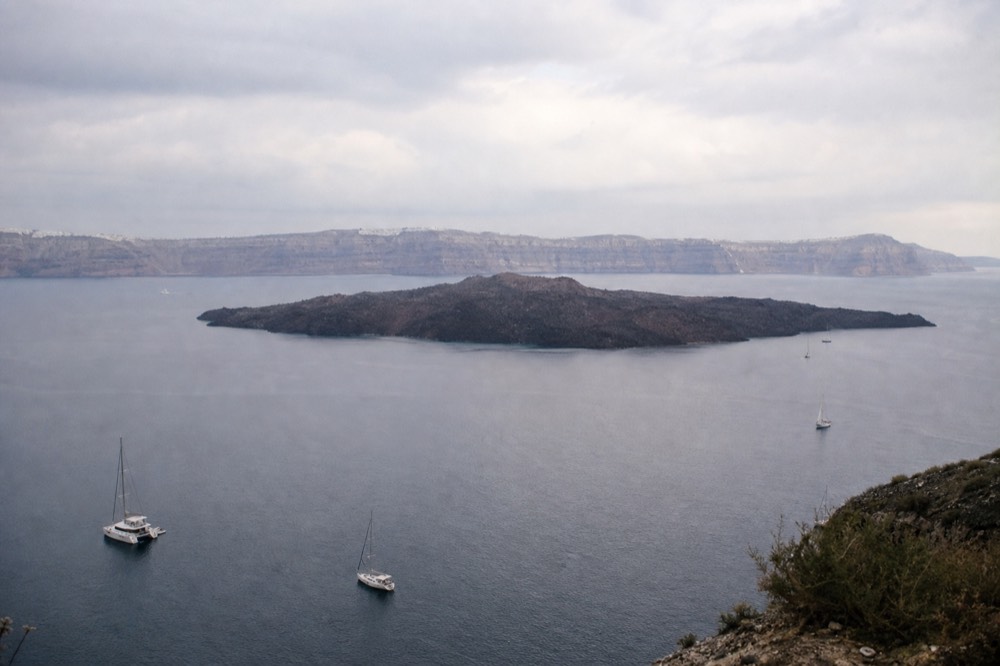
Nea Kameni is the young black island in the centre of the caldera, the active cone, with a marked crater trail and a landing fee. Thirassia is the far side of the old rim, a proper inhabited island across the water that the sun goes down behind. Sunset sails pass both; day trips are the ones that land on them.
The distinction matters when you are choosing a boat, because a lot of listings mention the volcano without promising a landing. A sunset circuit is built around light and dinner, so it sails past the black island and anchors at the warm water next door. A morning volcano trip is built around the walk, which takes an hour or more on exposed rock and costs a small entrance fee paid on arrival.
Thirassia is the piece of the original rim that survived on the western side. Small population, a couple of settlements, a harbour, and from a boat inside the caldera it is the silhouette that the sun drops behind at the end of the evening. Landing there is a day-trip thing, usually combined with the volcano walk and lunch ashore.
| Nea Kameni | Palea Kameni | Thirassia | |
|---|---|---|---|
| What it is | active volcanic cone, black rock | older lava island | inhabited fragment of the old rim |
| Why boats stop | crater hike, on day trips | hot springs anchorage | lunch and a harbour, on day trips |
| On a sunset sail | passed, usually not landed | anchored off, swim stop | the silhouette the sun sets behind |
| Landing fee | yes, paid on arrival | none, no landing at all | none |
| Shade | none, fully exposed | none | village shade ashore |
| Time needed | 60 to 90 minutes on foot | 45 minutes to an hour at anchor | half a day |
If the crater walk is the part you want, do not try to buy it inside a sunset ticket. Book a morning volcano trip and a separate evening sail, which is a long but genuinely good day. The volcano side of the caldera in full covers the landing fee, the trail and the honest position on the 2025 seismic activity.
How long does a boat actually hold each stop?
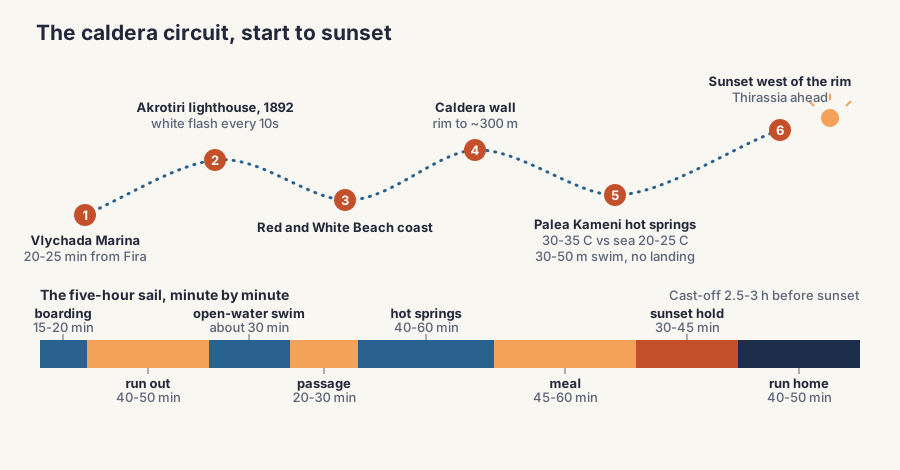
Five hours does not stretch. Subtract the run out and back, the sunset position and the meal service, and what is left for swimming is roughly ninety minutes split across two anchorages. Crews typically run the open-water swim at about half an hour and the hot springs at forty minutes to an hour, because the swim out and back eats time.
The arithmetic below is what a standard five-hour circuit has to fit into the clock, not a published timetable. Operators shift it around the wind and the light on the day, and a captain who finds a flat anchorage in September will hold it longer than one fighting a northerly in July.
| Segment | Roughly how long | What is happening |
|---|---|---|
| Boarding and briefing | 15 to 20 minutes | safety talk, drinks poured, lines off |
| Run to the first water | 40 to 50 minutes | the cape or the cliff wall, depending on start |
| Open-water swim stop | around 30 minutes | stern ladder, deep blue, no beach |
| Passage to Palea Kameni | 20 to 30 minutes | crossing the middle of the caldera |
| Hot springs anchorage | 40 to 60 minutes | the 30 to 50 m swim each way, plus time in the warm water |
| Meal service | 45 to 60 minutes | grill line or courses, at anchor |
| Sunset position and hold | 30 to 45 minutes | engines down, west of the rim |
| Run home | 40 to 50 minutes | blue hour, usually the calmest leg |
What that table really shows is why guest cap changes the trip more than the itinerary does. A 55-guest boat and a 16-guest boat hold the hot springs for a similar length of time, but on the big boat a chunk of that window is spent queuing at the ladder and waiting for the last swimmers back aboard. Small boats do not have more time. They have less overhead. The 20-guest Luxury Day-or-Sunset Catamaran is the clearest example, capped at a third of the classic boats with a fresh Greek meal and an open bar including a cocktail from $128, and it runs a morning slot as well if you would rather keep the evening free: check availability for your dates.
Wind is the other variable that rearranges everything. The meltemi blows June to September, hardest in July and August, typically four to seven Beaufort with peaks past eight, and it usually builds midday then eases toward evening. That timing is why sunset departures survive afternoons that look unsailable from a balcony, and why the ride home is normally the smoothest hour. The sailing reference on what the meltemi does across the Aegean is a good ten minutes of reading before a July booking.
Which of the seven boats run the full circuit?
All seven sail the caldera and all seven include the hot springs or swim stops in some form, but they differ in where they start, how many people share the anchorage, and what arrives at the table. Guest caps run from 130 down to 16, plus one private charter whose route flexes with the captain.
| Cruise | Departs | Guest cap | Meal | Rating and reviews | Price |
|---|---|---|---|---|---|
| Caldera Classic Catamaran | pickup included | shared | BBQ, unlimited dry white wine | 4.9, 514 | from $111 |
| BBQ Sunset Catamaran | pickup included | max ~55 | BBQ, unlimited wine, beer, softs | 4.6, 6,951 | from $75 |
| Luxury Day-or-Sunset Catamaran | pickup included | max 20 | fresh Greek meal, open bar with a cocktail | 4.8, 4,175 | from $128 |
| Aphrodite Volcano & Dinner Cruise | old port of Fira | max 130 | Greek buffet dinner, wine with it | 4.5, 230 | on the listing |
| Luxury Sunset Dinner Cruise | Ammoudi | shared | mezedes, BBQ, dessert, full open bar | 4.8, 158 | from $177 |
| Romantic Sunset Catamaran | Ammoudi | max 16 | appetizers and BBQ, wine, ouzo, beer | 4.7, 345 | on the listing |
| Private Wind Spirit Sunset | Vlychada | private | full Greek dinner | 5.0, 50 | per group |
The highest-rated shared boat on that list is the Caldera Classic at 4.9 across 514 reviews, a Renieris family operation that runs the circuit with a BBQ meal, unlimited dry white wine and hotel pickup from $111. Family-run boats tend to score like that because the person cooking has their name on the business. If it fits your dates, check availability and the live price.
Read the review counts as booking volume rather than quality. The BBQ boat's 6,951 reviews against the dinner cruise's 158 is a gap in seats sold per night, not a verdict. Everything in this fleet scores between 4.6 and 5.0, which means the choice is about the shape of your evening, not about avoiding a bad boat. The fleet compared as physical boats goes deeper on caps, bars and deck space, and the classic shared sails sit together on the homepage if you want to scan cards instead.
What should you bring, and who should skip the circuit?
Bring a dark swimsuit, a real layer for the ride home, a towel if your boat does not supply one, and shoes you can move in on a wet deck. Skip the circuit if you cannot swim in open water, if five hours at sea is more than your stomach or schedule allows, or if you are ashore for a single cruise-ship port call.
| Item | Why | Skip it if |
|---|---|---|
| Dark swimsuit | hot-springs minerals stain pale fabric permanently | you are not going in the water |
| Warm layer | blue-hour deck plus wind plus wet swimsuit is cold | never, bring it anyway |
| Towel | supplied on some boats, not all | your listing says towels included |
| Sunscreen | fully exposed deck for hours | you plan to sit in the saloon |
| Sunglasses with a strap | glare off water plus wind | you do not mind losing them |
| Flat shoes | wet decks and stern ladders | you are comfortable barefoot |
| Cash | small extras, and the volcano fee on day trips | you are only doing the sunset sail |
| Motion-sickness tablets | meltemi peaks July and August | you never get seasick |
Cruise passengers are the group most likely to be disappointed, and it is a timing problem rather than a quality one. Tendering into Fira is managed under a 70-30 rule across the two ports with a daily visitor cap in place, and a five-hour sail plus transfers rarely fits inside a shore window. The cruise-port day guide sets out what does fit.
Anyone prone to seasickness should think about the month rather than the boat. Catamarans are the stable choice, and a sunset slot lands after the wind has usually eased, but July and August afternoons can still be lively out on the cape. The month-by-month sailing scorecard puts wind, sea temperature and crowds in one table. And if you are still deciding whether any of this earns its price, whether a boat trip here is worth doing works through the arithmetic against staying ashore.
Timing inside the season matters more than most people expect. Early May and late September deliver the identical route with fewer boats sharing the hot-springs cove and calmer wind than a July afternoon. What you give up is evening length: a May sunset lands at 20:19 and a late-September one at 19:28, so you are alongside in real darkness rather than blue light. Peak July and August buy the longest evenings and cost you elbow room at every anchorage on the circuit.
For everyone else the circuit is the most efficient day on the island. One booking covers the geology, the swim, the meal and the sunset, with the boat doing the moving. Pick the departure point that matches where you sleep, then the guest cap you can live with, and the seven-boat list narrows to two or three in about four minutes. All of them sit side by side across santorini sunset cruises if you would rather compare cards than prose.
Common questions
What is included in a Santorini caldera boat tour?
On the seven boats here: a five-hour sail around the caldera, one or two swim stops, an anchorage off the Palea Kameni hot springs, a meal cooked on board, and drinks ranging from unlimited white wine to a full open bar. Most include hotel pickup. All seven cancel free up to 24 hours before departure.
How long is a caldera boat tour?
Five hours is the standard on the catamaran fleet, casting off two and a half to three hours before sunset. Inside that, expect roughly forty to fifty minutes running out, about thirty minutes at an open-water swim stop, forty to sixty minutes at the hot springs, an hour for the meal, and a sunset hold of thirty to forty-five minutes.
Can you swim in the Santorini hot springs?
Yes, and you have to swim to reach them. There is no dock and no landing at Palea Kameni, so boats anchor offshore and guests swim 30 to 50 metres into the shallow cove. The geothermal pockets hold 30 to 35 C against a sea of 20 to 25 C. The iron content stains pale swimwear permanently, so wear dark.
Do caldera boat tours stop at Thirassia?
Sunset sails generally do not land there. Thirassia is the inhabited fragment of the old caldera rim on the western side, and from an evening boat it is the silhouette the sun goes down behind. Landings at Thirassia are a day-trip feature, usually paired with the Nea Kameni crater walk and lunch ashore.
Where do caldera boat tours leave from?
Three of the seven include hotel pickup, so you never deal with a port. Two leave from Vlychada Marina on the south coast, a flat twenty to twenty-five minute drive from Fira with parking and an ATM on site. Two board at Ammoudi Bay, roughly 300 steps below Oia at the end of a switchback road.
What happens if the weather cancels the trip?
The operator makes the call on the day and offers a reschedule or a full refund. That sits on top of free cancellation up to 24 hours before on all seven boats. The meltemi blows hardest in July and August, typically four to seven Beaufort, usually building midday and easing toward evening, which is why sunset departures often sail when afternoons look rough.
Plan your evening on the water
Check the cruise that fits your evening
Initial editorial choice, not a personalized eligibility check. Confirm the operator’s full requirements before booking.
Which boat runs the circuit the way you want?
This screens only the details you enter. Language, boarding, sea state and every remaining restriction still need operator confirmation. Time allowances include boarding and the return leg.
- Caldera Classic Catamaran - the best-rated boat on the board, a Renieris family catamaran with a BBQ meal and dry white wine at a calmer scale than the big fleets. about 5 hours (confirm on the listing). From $111 per person. Shared catamaran; the listing confirms departure time and duration for your date.
- BBQ Sunset Catamaran - the full caldera circuit, a BBQ dinner cooked on board and unlimited wine and beer at the island's lowest published price. 5 hours. From $75 per person. Big shared catamaran, around 55 guests. Sunset departure is timed to the month's sunset hour.
- Aphrodite Volcano & Dinner Cruise - the only boat in our board that lands you on Nea Kameni for the guided volcano hike, then the hot springs, Thirassia and a buffet dinner with wine through the sunset. 6 hours. Price shown on the live listing. Around 130 guests. The EUR 5 volcano entrance fee is not included, the hike needs sturdy shoes, and the hot springs are reached by a 30-metre swim. Without pickup, it meets at the Old Port of Fira (cable car EUR 10 each way or a 30-minute walk down).
Caldera Classic Catamaran
Check your date before arranging the rest of your day: the best-rated boat on the board, a Renieris family catamaran with a BBQ meal and dry white wine at a calmer scale than the big fleets.
about 5 hours (confirm on the listing). Hotel pickup, caldera swim stops, hot springs, BBQ meal cooked aboard, unlimited dry white wine and soft drinks.
Shared catamaran; the listing confirms departure time and duration for your date.
Schedule loading. You can still check dates directly on Viator below.
Scheduled dates are not confirmed seats. Select the same date on Viator to confirm availability and the final price.