The Best Month for a Sunset Cruise in Santorini (2026)
Seven months of sailing, one sun that moves nearly two hours across them, and a wind that decides how the middle of the season feels.
Short answer
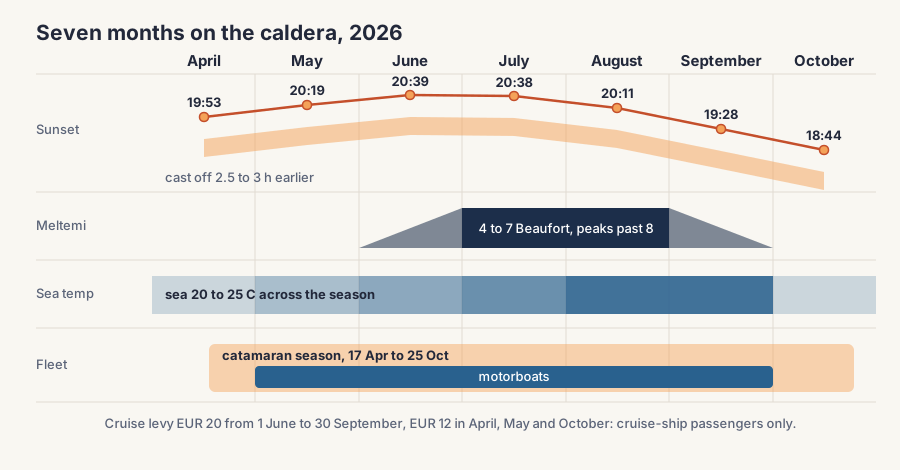
Late May and September are the sweet spot: the fleet is running, the meltemi is not at its worst, and the island is not at full pressure. June and July give the latest sunsets, 20:39 and 20:38, but the strongest wind and the biggest crowds. April and October sail in a much shorter day, with the sun down by 19:53 and 18:44.
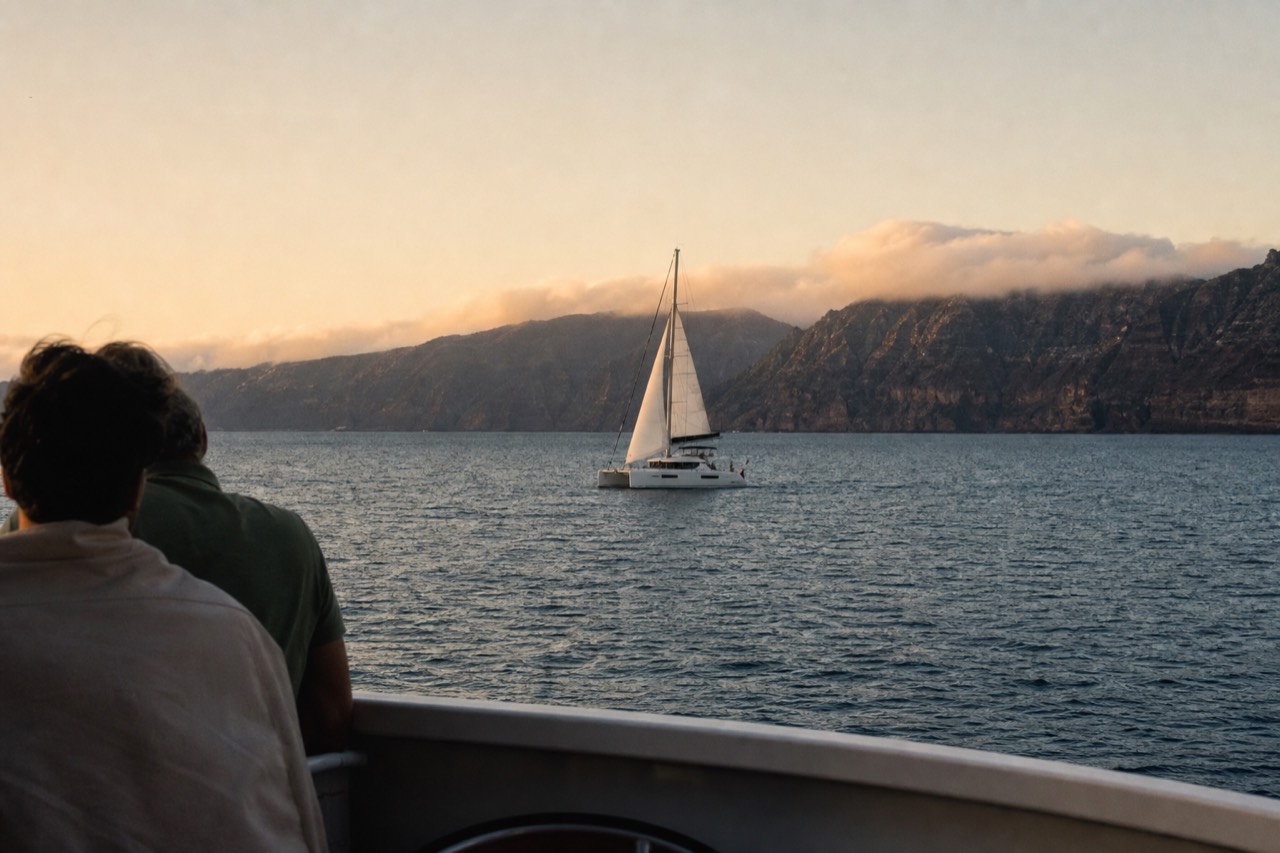
The first boats of the season leave in a light that does not look like the postcards. April water is glassy and grey-blue, the cliffs are still damp in places, and the sun is gone by ten to eight. By late June the same crossing happens in hard gold at nearly nine in the evening, with a northerly still dying off the rim. Same route, same five hours, two different holidays.
Booking choice: If the month is fixed but the slot is open, the Luxury Day-or-Sunset Catamaran is the seasonal all-rounder: a morning run before the meltemi fills in or the sunset circuit, twenty guests, from $128. The season runs 17 April to 25 October, and every boat cancels free up to 24 hours out.
Choosing a month here is really choosing between four things that refuse to peak together: light, water temperature, wind and crowd. No month wins all four. Knowing which one you care about is most of the decision, and comparing every boat across santorini sunset cruises afterwards takes about four minutes.
When is the best month to sail the caldera at sunset?
Late May and September are the strongest all-round months. The fleet is running, the water has warmed or has not yet cooled, the meltemi is either not started or already easing, and the island is off its peak. July and August give the biggest evenings and the hardest conditions. April and October are cheaper, quieter and much shorter days.
The catamaran fleets book 17 April to 25 October for 2026, so that is your outer frame. The smaller motorboats mostly hold to May through September, which means the very first and very last weeks of the season are catamaran territory by default. That is no bad thing, since a big cat is the most stable platform on the caldera when the water is not perfectly flat.
Within that frame, the trade-offs move in opposite directions. Light and heat climb from April to a July peak. Wind climbs with them. Crowds follow the flights. Water temperature lags everything, which is why September swims better than June despite being a dimmer month on paper. Anyone building a trip around the water rather than the photograph should read that sentence twice.
If you only have one evening on the island, the month matters less than the slot. Cast-off is 2.5 to 3 hours before sunset in every month, and the operator makes the weather call on the day with a reschedule or a full refund if the wind wins. Book early in your stay and keep a spare evening. The full 2026 price ladder covers what each tier costs before you pick a date.
What time does the sun actually go down, month by month?
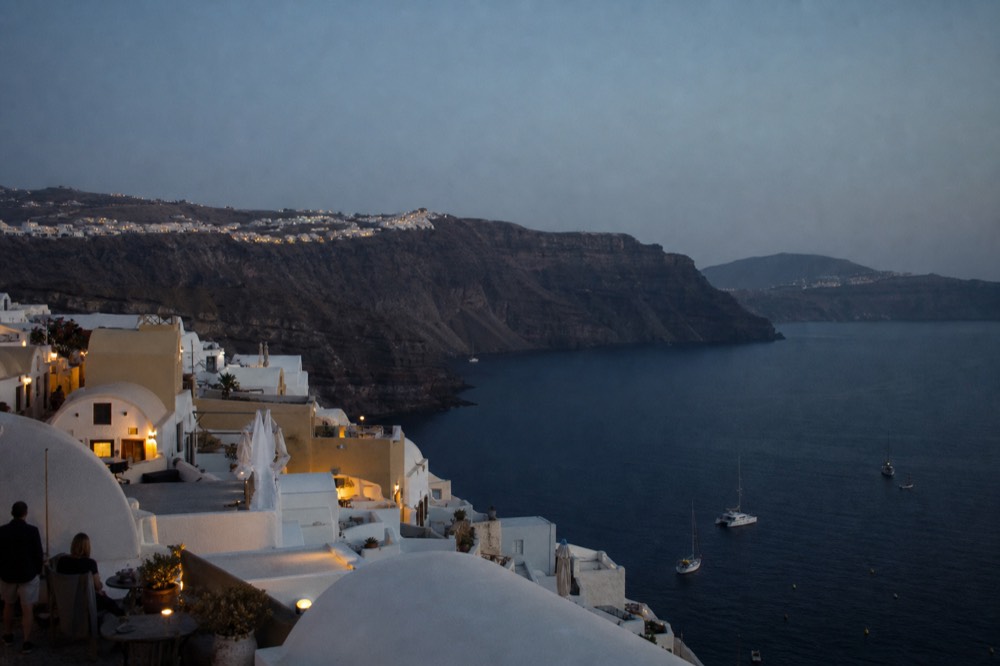
Sunset at Thira moves by nearly two hours across the season. Mid-month it falls at 19:53 in April, 20:19 in May, 20:39 in June, 20:38 in July, 20:11 in August, 19:28 in September and 18:44 in October. Boats cast off 2.5 to 3 hours earlier, so an October sail starts in mid-afternoon.
| Month | Sunset at Thira, mid-month | Typical cast-off | Back on the dock, roughly | Fleet |
|---|---|---|---|---|
| April | 19:53 | 16:53 to 17:23 | 21:53 to 22:23 | catamarans from 17 April |
| May | 20:19 | 17:19 to 17:49 | 22:19 to 22:49 | full fleet, motorboats start |
| June | 20:39 | 17:39 to 18:09 | 22:39 to 23:09 | full fleet |
| July | 20:38 | 17:38 to 18:08 | 22:38 to 23:08 | full fleet |
| August | 20:11 | 17:11 to 17:41 | 22:11 to 22:41 | full fleet |
| September | 19:28 | 16:28 to 16:58 | 21:28 to 21:58 | full fleet |
| October | 18:44 | 15:44 to 16:14 | 20:44 to 21:14 | catamarans to 25 October |
That table decides more about your day than the weather does. A June sail eats the whole evening: you leave at six, you are back near eleven, and dinner ashore afterwards is not happening. An October sail leaves at quarter to four and has you back on the rim by nine, which fits a normal evening perfectly and is the single most underrated argument for the late season.
Notice how flat the peak is. June and July differ by one minute at the solstice end, then August drops 27 minutes and September another 43. The season falls off a cliff in autumn, and the drop from September to October is nearly three quarters of an hour. Check the exact sunset for your date rather than working off the mid-month figure, because a late-September booking behaves like an October one.
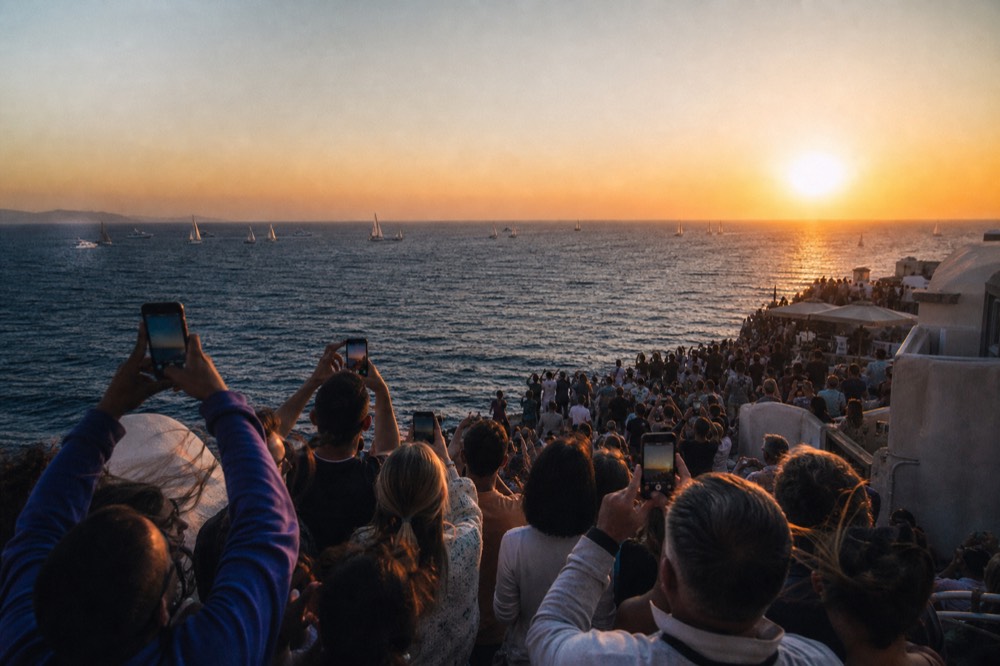
One thing to set straight, since half the visitors on the island get it wrong: the sun does not go down over Oia. From inside the caldera it drops behind Thirassia and the open water past it, which is exactly why a boat sitting west of the rim has the better seat than any terrace. The caldera circuit stop by stop covers what you pass on the way out to that position, and why this sunset got its reputation explains how the same geometry turned into a nightly event.
How warm is the water, and does it change your evening?
The caldera sea sits between 20 and 25 degrees across the sailing season, coldest at the edges and warmest at the end of summer. The hot springs at Palea Kameni run 30 to 35 against that, reached by a real 30 to 50 metre open-water swim. In April and October the swim stop becomes optional for most people.
| Month | How the water feels | Swim stops | The hot-springs swim |
|---|---|---|---|
| April | brisk, short dips, most guests stay dry | crew still offer them | the warm inlet is the draw, the crossing is cold |
| May | cool but fine after the first shock | most people go in | comfortable, the contrast is at its sharpest |
| June | warming week by week | busy ladder | easy, warm inlet against cool sea |
| July | properly warm | everyone swims | easy, and the sea has caught up |
| August | the warmest stretch of the year | everyone swims | the contrast is least dramatic |
| September | still warm, no shock going in | everyone swims | comfortable, the quietest month for it |
| October | cooling, brief swims | offered, taken up less | the inlet still feels warm, the swim back does not |
Sea temperature is the reason September beats June for anyone whose priority is the water. June has 45 more minutes of daylight and a colder sea, because the Aegean takes all summer to heat and holds it into autumn. If your mental image of this trip is floating on your back in the caldera at dusk, September is the month you want and it is not close.
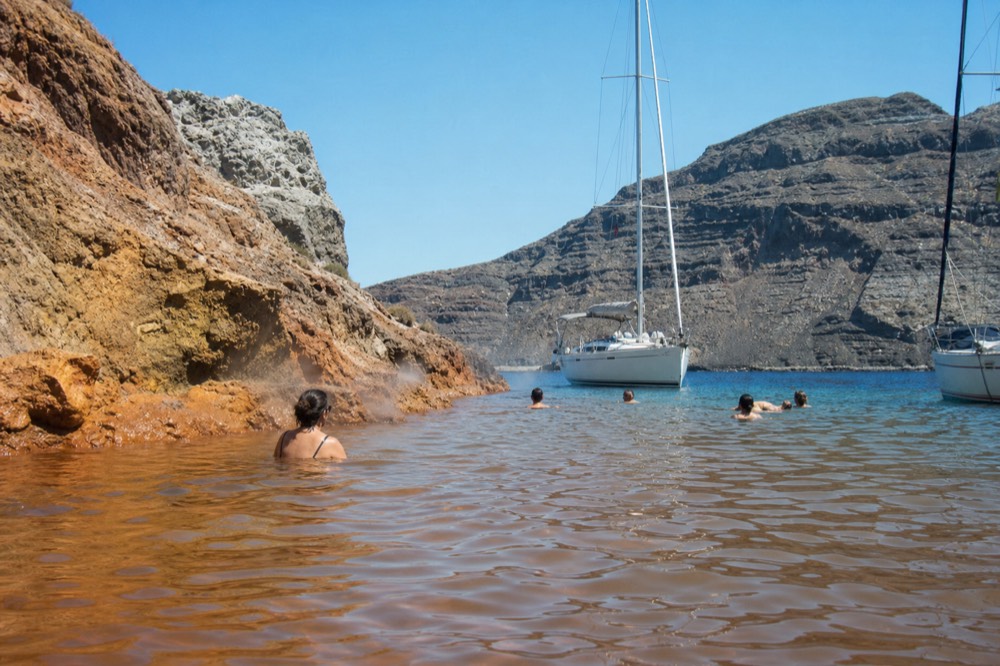
The hot springs are the stop that surprises people, and the surprise is physical. The warm water sits in a shallow rust-coloured inlet at Palea Kameni, the iron and sulfur in it will stain a pale swimsuit permanently, and you reach it by swimming 30 to 50 metres from the anchored boat because no hull goes into that shallow. Wear something dark and expect the swim, not a walk-in spa. Crews say the same line on every boat in the fleet.
Non-swimmers should think about this before choosing a month rather than after. In July an hour at anchor with everyone else in the water is a pleasant hour on deck. In April it is the same hour with nobody to watch. A dinner-led sail moves the value of the evening to the table instead, which is a better fit at either edge of the season.
None of that changes the water temperature, but it changes how many people are in it with you. A boat that caps at 20 guests holds its shape through the busiest weeks of a busy summer, which is the practical reason the small-group tier books out first on peak dates.
Which months does the meltemi blow, and what does it do to a sail?
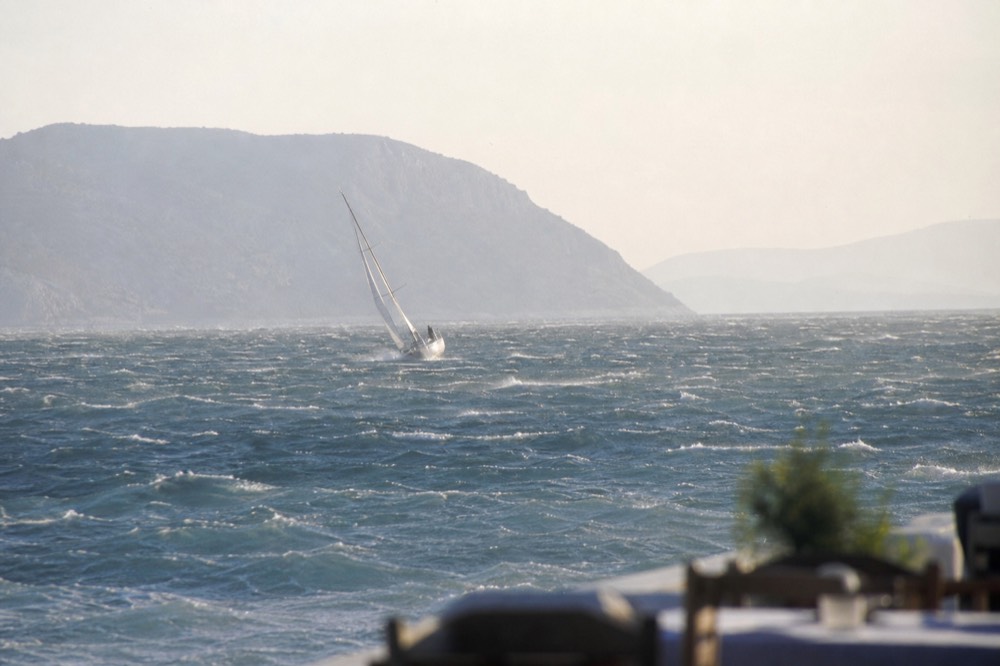
The meltemi is a dry northerly that runs June to September and blows hardest in July and August, typically 4 to 7 Beaufort with peaks past 8. It usually builds through the middle of the day and often eases toward evening, which is why sunset departures sail on afternoons that look impossible from a balcony.
| Month | Meltemi | Typical strength | Daily pattern | What it means on deck |
|---|---|---|---|---|
| April | outside the season | light and variable | calm mornings | flat water, cool air, bring a layer |
| May | outside the season | light | occasional breeze | the easiest sailing conditions of the year |
| June | starting | 4 to 6 Beaufort on windy days | builds midday | spray on the trampoline, evening usually settles |
| July | at its hardest | 4 to 7, peaks past 8 | strong from late morning | wettest bows, most weather calls |
| August | at its hardest | 4 to 7, peaks past 8 | strong from late morning | same, plus the fullest boats |
| September | easing | 4 to 6, fading through the month | milder afternoons | the best wind-to-warmth balance of the season |
| October | outside the season | light | calm | flat evenings, early sunset |
Five summers of crew work out of Vlychada teaches you to read this by lunchtime rather than by forecast. A hard northerly at two in the afternoon has flattened by six often enough that the fleet still casts off, and the run home under the cliffs in the blue hour is usually calmer than the way out. What the wind changes is comfort, not safety: a catamaran does not roll like a monohull, but a beam sea slaps the underside of the bridgedeck and everybody sitting forward gets wet. Sit aft in July.
The other thing the meltemi does is shift the value of a morning departure. One boat in this fleet runs both a morning and a sunset slot, and in the peak weeks that flexibility is worth more than any inclusion on the list, because mornings are the calm half of a windy day. If you are travelling in July or August with anyone prone to seasickness, check which slots are open on your dates before you commit to an evening.
When the wind does win, nothing bad happens to your money. The operator calls it on the day, you take a reschedule or a full refund, and that sits on top of free cancellation up to 24 hours before on all seven boats. For the sailing view of what the meltemi does across the Aegean, the reference is worth ten minutes before you book a windy-month date.
When is the island busiest, and what does that cost you?
Pressure tracks flights and ships, and both peak from late June to early September. Cruise calls drop to 595 for 2026 under an 8,000-a-day visitor cap, while air traffic is climbing again. Shoulder months bring room rates 30 to 50 percent below the July and August peak.
| Season block | Cruise levy per ship passenger | Room rates against peak | Fleet | How the island feels |
|---|---|---|---|---|
| April and May | EUR 12 | 30 to 50 percent lower in the shoulder | catamarans from 17 April, motorboats from May | quiet lanes, cool evenings, easy tables |
| June to September | EUR 20 | peak | everything running | full boats, sell-out flags, ships capped at 8,000 a day |
| October | EUR 12 | falls back toward shoulder levels | catamarans to 25 October | emptying fast, early sunsets, good value |
| November to March | EUR 4 | lowest of the year | caldera sunset fleet not sailing | out of season for this trip |
Two numbers explain 2026 better than any crowd anecdote. Scheduled cruise calls fall to 595, down more than 18 percent on last year's 728, because the daily cap is now calculated against full ship capacity rather than an assumed 80 percent load. Meanwhile the airport, which took 2,418,219 passengers in 2025 after a record 2,877,122 in 2024, is running about 26 percent ahead in early 2026. Fewer day-trippers off ships, more people staying. On the water that reads as busier boats and a slightly calmer Fira.
The levy itself gets misread constantly, so here it is plainly. From 1 June to 30 September a cruise passenger arriving at Santorini pays EUR 20, dropping to EUR 12 in April, May and October and EUR 4 over winter. It is charged to the onboard account and collected by the cruise line. It has nothing to do with booking a catamaran, no marina collects it, and no boat in this fleet adds it to your seat. The cruise-port day guide works through what ship passengers actually face.
For a sailing traveller the practical effect of crowd is simpler: peak dates sell out. Several boats carry live sell-out flags on 2026 summer dates, and the cheapest tier goes first because it always does. Booking three or four weeks out in July costs nothing given the 24-hour free cancellation, and it is the difference between the boat you wanted and the boat that had room. The cheapest full evening on the caldera starts at $75, and you can check which summer dates are still open before the peak weeks fill.
| Cruise | Guest cap | Rating | Reviews | Peak-date pressure showing | Cancellation |
|---|---|---|---|---|---|
| BBQ Sunset Catamaran | shared, max ~55 | 4.6 | 6,951 | likely to sell out | free to 24 h |
| Caldera Classic Catamaran | shared | 4.9 | 514 | no flag showing | free to 24 h |
| Luxury Day-or-Sunset Catamaran | max 20 | 4.8 | 4,175 | likely to sell out | free to 24 h |
| Aphrodite Volcano & Dinner Cruise | shared, max 130 | 4.5 | 230 | booked 5+ times last week | free to 24 h |
| Luxury Sunset Dinner Cruise | shared | 4.8 | 158 | likely to sell out | free to 24 h |
| Romantic Sunset Catamaran | max 16 | 4.7 | 345 | booked 5+ times last week | free to 24 h |
| Private Wind Spirit Sunset | private | 5.0 | 50 | no flag showing | free to 24 h |
Are April and October worth it?
Yes, for the right traveller. Both edges give you cheap rooms, empty lanes, flat water and a full catamaran fleet. What you give up is swimming, an hour of evening light and the motorboat options. April opens on the 17th and October closes on the 25th, and outside those dates the caldera sunset fleet is not sailing.
The two edges are not symmetrical, and the difference is worth understanding before you pick one. April opens on the 17th with the coldest water of the sailing season, no motorboats yet, and a cast-off around five that has you back on the dock near ten. October closes on the 25th with water still holding summer heat, a cast-off nearer quarter to four, and a return by nine. Both sit outside the meltemi season, both fall in the cheaper levy tier for ship passengers, and both put you on a half-empty deck.
October is the stronger of the two edges and the one I would send most people to. The water is still holding summer heat, the wind has gone, the boats are half full, and a mid-afternoon cast-off means you finish the sail in time for a proper dinner on the rim. The only real cost is daylight: you are swimming at four in the afternoon rather than seven in the evening, which feels odd for exactly one stop and then feels fine.
April is the specialist's month. The island is green in a way nobody photographs, the light is soft rather than gold, and you will have the hot springs almost to yourself. You will also be one of the few people in the water. If the swim is the point of the trip, come later. If the caldera, the sail and the quiet are the point, the first two weeks the fleet runs are the best-value sailing of the year.
Both edges share one risk worth naming: a shorter season means fewer spare dates. Lose an evening to weather in October and there may not be another sailing before the fleet stops for the winter. Book the first bookable evening of your stay, not the last. And since people still ask, the 2025 earthquake swarm is over: the island has been seismically quiet through 2026 and boats are running their normal schedules, at both ends of the season.
Which month suits which traveller?
Match the month to the one thing you will not compromise on. Swimmers want September. Photographers want June. Anyone travelling with a tight budget or a low tolerance for crowds wants April, May or October. Families with young children should avoid the meltemi peak in July and August.
| If you are | Go in | Because |
|---|---|---|
| Here mainly to swim | September | the sea is at its warmest and the wind has eased |
| Chasing the longest golden evening | June | sunset at 20:39, the latest of the season |
| Travelling on a budget | April, May or October | rooms 30 to 50 percent under peak, boats not full |
| Sensitive to motion or seasick | May, September or October | the meltemi is absent or fading, water is flattest |
| Bringing young children | May or September | warm enough water, calm afternoons, shorter queues |
| Fitting a sail around dinner ashore | October | cast-off at 15:45 puts you back on the rim by nine |
| Travelling in the peak anyway | July or August | book early, take a morning slot if the wind is up |
The two mistakes I see most often are booking August for the sunset and booking June for the swim. August evenings are 28 minutes shorter than June's and the boats are at their fullest. June water is noticeably cooler than September's, which catches out anyone who assumed early summer means warm sea. Both trips are still good. They are just not the trips people thought they were buying.
Couples get a third option that has nothing to do with weather. The smallest shared boat in the fleet caps at 16 guests, which changes a busy month more than a calm one does: in July, a 16-guest deck feels like the shoulder season even when the island does not. That is a legitimate way to buy quiet without moving your dates, and the boat-by-boat comparison sets the caps out side by side.
Which boat suits which month?
Format matters more at the edges of the season than in the middle. In April and October a served meal beats a swim-led circuit, and a bigger hull rides flatter. In July and August a morning slot dodges the wind and a smaller guest cap dodges the crowd. Peak-month bookers should pick on cap, not price.
| Month | Pick this shape | Why | Example from the fleet |
|---|---|---|---|
| April | dinner-led or big hull | cool water makes the swim optional, the table carries the evening | Luxury Sunset Dinner Cruise, from $177 |
| May | anything | flattest water and a full fleet, no format is penalised | Caldera Classic Catamaran, from $111 |
| June | swim-led circuit | latest sunset, warming sea, long time at anchor | BBQ Sunset Catamaran, from $75 |
| July | morning slot or small cap | the wind builds midday, the boats are full | Luxury Day-or-Sunset Catamaran, from $128 |
| August | small cap, book early | the warmest water and the fullest decks of the year | Romantic Sunset Catamaran, price on the listing |
| September | swim-led circuit | the best water of the season and an easing wind | Aphrodite Volcano & Dinner Cruise, price on the listing |
| October | dinner-led or private | mid-afternoon cast-off, cooling sea, quiet marinas | Private Wind Spirit Sunset, per group |
The one boat that changes with the season more than any other is the private charter, because the route flexes with the captain rather than following a fixed circuit. In May or October, when nothing is crowded, that flexibility means going where the light is instead of where the schedule says. Six people splitting a per-group quote in the shoulder is the best-value private sailing on the island, and you can see the open sailing dates on the listing.
The one thing that does not change with the month is the shape of the evening: cast off, run the cliff wall, swim, anchor off the volcano, eat, then watch the sun go from open water. For what happens on that circuit and how the volcano stops fit into it, the volcano side of the caldera is the closer look, and the exact best hour to be on the water answers the timing question on its own.
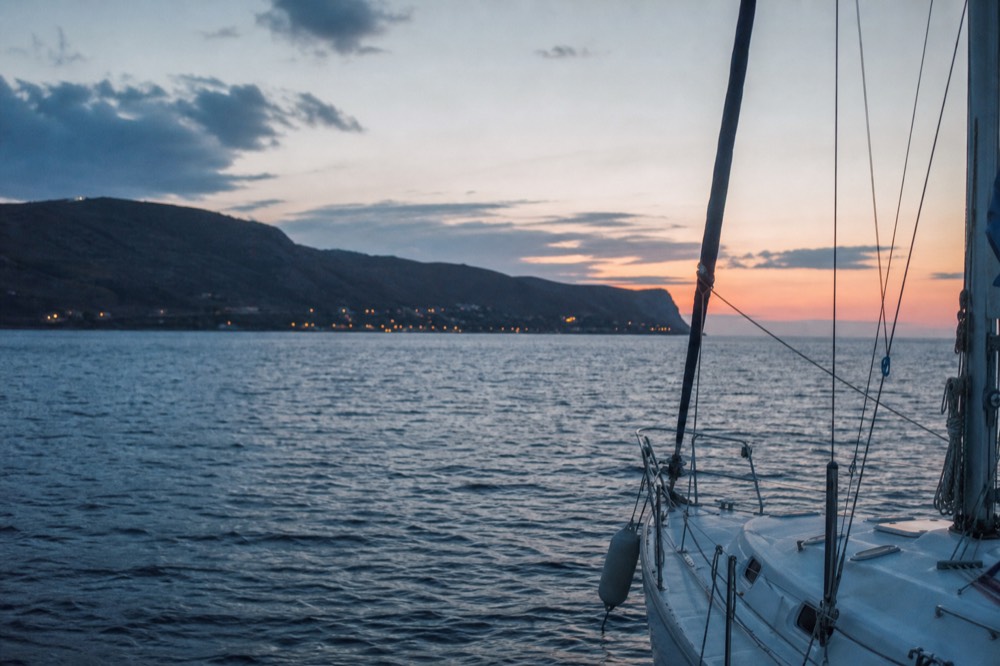
Pick the month for the thing you cannot buy twice, then pick the boat for the month. If the small-group boats are where you land, the cap does more for a July evening than any weather forecast will.
Common questions
What is the best month for a sunset cruise in Santorini?
Late May and September score best overall. Both have a full fleet, calm-to-easing wind, and an island short of its peak. September has the warmest water of the year, which makes it the pick for swimmers. June gives the latest sunset at 20:39 but a cooler sea, and July and August bring the strongest meltemi and the fullest boats.
What time does the sun set in Santorini?
Mid-month at Thira the sun goes down at 19:53 in April, 20:19 in May, 20:39 in June, 20:38 in July, 20:11 in August, 19:28 in September and 18:44 in October. Boats cast off 2.5 to 3 hours before that, so an October departure leaves around 15:45 and a June one closer to 18:00.
Is the water warm enough to swim in April or October?
The caldera sea runs 20 to 25 degrees across the season, coldest in April and cooling through October. Crews still offer the swim stops at both edges and some guests take them, but most stay dry. The hot springs at Palea Kameni sit at 30 to 35 degrees and are reached by a 30 to 50 metre open-water swim from the anchored boat.
Will the meltemi cancel my sailing?
Sometimes, mostly in July and August. The meltemi is a northerly that blows June to September at 4 to 7 Beaufort with peaks past 8, usually building around midday and easing toward evening. The operator makes the call on the day and offers a reschedule or a full refund, and every boat in this fleet also cancels free up to 24 hours before.
When does the sunset cruise season start and end?
The main catamaran fleets book 17 April to 25 October for 2026. The smaller motorboats mostly run May through September, so the first and last two weeks of the season are catamaran-only. Outside those dates the caldera sunset fleet is not sailing, which is worth knowing if you are planning a late October or early April trip.
Do I pay the EUR 20 Santorini levy if I book a boat trip?
No. The levy is charged to cruise-ship passengers arriving at Santorini, at EUR 20 from 1 June to 30 September and EUR 12 in April, May and October. Cruise lines bill it to the onboard account. It is not applied to day-sail bookings, no marina collects it, and no boat in this fleet adds it to a seat price.
Plan your evening on the water
Check the cruise that fits your evening
Initial editorial choice, not a personalized eligibility check. Confirm the operator’s full requirements before booking.
Which month and slot suits your evening?
This screens only the details you enter. Language, boarding, sea state and every remaining restriction still need operator confirmation. Time allowances include boarding and the return leg.
- Luxury Day-or-Sunset Catamaran - twenty guests instead of fifty, a fresh Greek meal, an open bar that includes a cocktail, and the only boat here that lets you pick a quiet morning sail or the sunset run. About 5 hours, morning or sunset departure. From $128 per person. Maximum 20 guests. The morning departure swims in different light; sunset departs later and runs the same circuit.
- Romantic Sunset Catamaran - a 16-guest catamaran built for couples: appetizers, a BBQ dinner, an open bar with wine, ouzo and beer, and crew who pace the evening around the light. about 5 hours. Price shown on the live listing. Maximum 16 guests. Transfer is optional, not bundled; confirm the meeting point when you pick a date.
- Luxury Sunset Dinner Cruise - a dinner table that sails through the sunset: mezedes, then BBQ courses, then dessert, with a full open bar and air-conditioned minibus pickup. evening, dinner served in courses (confirm timing on the listing). From $177 per person. Shared luxury boat. Dinner is served through the evening rather than at a fixed table time; the listing confirms your date's schedule.
Luxury Day-or-Sunset Catamaran
Check your date before arranging the rest of your day: twenty guests instead of fifty, a fresh Greek meal, an open bar that includes a cocktail, and the only boat here that lets you pick a quiet morning sail or the sunset run.
About 5 hours, morning or sunset departure. Hotel pickup, Greek meal, open bar including a cocktail, swim stops and the hot springs.
Maximum 20 guests. The morning departure swims in different light; sunset departs later and runs the same circuit.
Schedule loading. You can still check dates directly on Viator below.
Scheduled dates are not confirmed seats. Select the same date on Viator to confirm availability and the final price.